HEALTH ANXIETY Do any of these sound like you?

HEALTH ANXIETY. Do any of these sound like you?
Worrying that minor symptoms or body sensations mean you have a serious illness

Frequently searching the internet for causes of symptoms or possible illnesses

Being preoccupied with having or getting a serious disease or health condition

Worrying excessively about a specific medical condition or your risk of developing a medical condition because it runs in your family
Repeatedly checking your body for signs of illness or If you struggle with health anxiety, chances are you’ve experienced at least one of these symptoms before and have felt especially panicked during the pandemic…but here are the facts as a psychologist (disclaimer: this post is NOT meant to diagnose or treat, but merely to inform you more on the specifics from a clinical perspective):

There are two types of health anxieties: Somatic Symptom Disorder and Illness Anxiety Disorder (formally known as hypochondriasis).

Many people with health anxiety fear they are ill or will contract a disease…and this consumes their mind—ALL. THE. TIME.

Many people obsess over bodily functions (such as breathing or heartbeat) or physical discomfort (headaches, stomach aches, lightheadedness).

Some might worry about a specific organ (such as the brain or heart) or be preoccupied by a disease you heard about on the news or at work

People who struggle with health anxiety may also be preoccupied with the belief that they have, or are in danger of contracting, a serious illness.

This fear of having a serious illness can interfere with your daily life and may even lead to unnecessary testing, wasted hours in the doctor’s office, and days consumed by worry.
So how can you begin healing?

Well remember… These health anxieties are a type of anxiety disorder, which is best treated by a licensed psychologist who specializes in anxiety disorders.

Treatment options may include medications and psychotherapy, often in the form of talk therapy, which can help you manage and move past your worries.

If you need help with how to start the therapy process, please don’t hesitate to DM me

Ways to REST when Exhaustion is at a Soul Level

Ways to REST when Exhaustion is at a Soul Level.

Go on a mindful nature walk

Light a candle and watch it flicker

Spend time in prayer or meditation

Do one thing slowly, and with intention

Get a 30-second hug from a safe person

Let your heart soften and have a good cry

Remind yourself, “I don’t have to earn my rest.”

Do less and take one thing off your plate today

Say no to something that just feels like too much

Allow yourself moments of solitude—not isolation

Allow yourself to cancel something you said yes to

Let a safe person see your vulnerability and struggle

Let yourself scroll awhile if it’s restful and not numbing

Do one thing for joy—not achievement or productivity

Lower the bar today—Let “good enough” be good enough

Unfollow anyone that makes you feel like you aren’t enough

Slow down—physically, mentally, relationally, and spiritually

There’s a kind of exhaustion that sleep just doesn’t fix.

The kind that comes from living in a chronic state of nervous system dysregulation and having an anxious brain that never shuts off.

From holding it all together when you’re unraveling inside.

It’s not just physical—it’s emotional, mental, and spiritual too.

And it asks for a different kind of rest. Not just naps and early bedtimes, but boundaries, softness, slowness, and being held—even if only by yourself.

Here are some ways to get the rest your soul needs when your fatigue goes beyond the need for sleep.

Which is your favorite? Let’s talk about it in the comments!

Need some uplifting reminders that encourage and inspire, even on the draining days? Get my new

FREE PDF, 50 Favorite Anxiety Affirmations sent right to your inbox by commenting 50 AFFIRMATIONS below!

Find this helpful? LIKE, SAVE, and SHARE with a friend or your community.

Anxiety in your 20’s

Anxiety in your 20’s.

I’ve been loving this series on what anxiety looks like in different decades, so today I want to share a little about my 20s.

Back then, I didn’t even know I had anxiety…I just knew I felt uncomfortable in my own skin. My self-esteem was low, and instead of coping in healthy ways, I numbed with partying, drinking, and unhealthy habits.

I buried emotions and old traumas because I didn’t know how else to deal. It wasn’t until my mid-30s that I finally started to feel at home in my own skin. Here are some tools I wish I had made more of a priority in my 20s.

Daily Tools for Anxiety in Your 20s

Get honest about who you spend your time with. Notice how friends make you feel-do they lift you

up or drain you?

Cut down on alcohol + numbing habits. They may give short relief but make anxiety worse long-term.

Start therapy if you can. Having a safe space to process emotions can change everything.

Create a mental health toolkit. Build coping habits like journaling, grounding, or breathwork.

Practice saying ‘no’ once a week to protect your peace and energy.

Stay single long enough to learn to love yourself before settling for less.

Try living alone or traveling solo. It builds independence and self-trust.

Anchor your day with one ritual (walk, playlist, or morning journaling) to feel grounded.

Your 20s don’t have to be about numbing or pretending. You’re allowed to choose healing, even if you don’t have it all figured out yet.

“Who am I supposed to be by now?”

“Everyone else has a career… what if I’m already behind?”

“What if I picked the wrong major/job and ruined my future?”

“They’re getting engaged, buying houses, traveling-and I can’t even pay rent.”

“Shouldn’t I have it all figured out by 25?”

“What if I fail before I even start?”

“If I say no, they’ll stop inviting me. But I’m exhausted.”

“Did I make the wrong choice moving here? Choosing this partner? Taking this job?”

“I should feel independent by now, but I can’t even afford it.”

“Why does every big life change feel like I’m about to fall apart?”

THE WORST THINGS ABOUT HAVING ANXIETY

THE WORST THINGS ABOUT HAVING ANXIETY

Believing you’re a burden to everyone.

Cancelling plans last minute.

Having an outburst over something that others may consider not a big deal.

Frequent crying and mood swings.

Isolating yourself from others.

Constantly waiting for something bad to happen.

Feeling unwell physically most of the time.

Inability to forgive yourself for making mistakes.

We all know there are some horrible things about having anxiety, like the things in this post. However, anxiety can also do us some good at times. It can heighten our awareness, motivate us to prepare for challenges, and even help us recognize and avoid potential dangers.

* If your anxiety is doing more harm than good, here are some tips to jumpstart your healing journey

1 Challenge negative thoughts and replace them with more realistic ones.

Often, those with anxiety tend to catastrophize and imagine worst-case scenarios. By consciously questioning these thoughts and evaluating the evidence for their validity, you can reduce the power they hold over you.

2 Do the work.

Taking care of your physical and mental well-being can significantly impact your anxiety levels. This includes adopting healthy lifestyle habits such as regular exercise, getting enough sleep, and eating a balanced diet. Also engaging in activities that bring you joy and relaxation, such as practicing , painting, or spending time in nature, can help Alice anxiety and promote a sense of calmness.

3 Seek support from a mental health professional. They can provide guidance, tools, and techniques tailored to your specific needs. Therapy can help you explore the root causes of your anxiety, develop coping mechanisms, and enhance your overall resilience in the face of stress.

* Remember, anxiety is a common human experience, and you are not alone in your struggles. The journey to anxiety healing may take time and effort, but with persistence and self-compassion, you can find relief and begin to fully enjoy life again.

TRAUMA AND HEALING

TRAUMA AND HEALING:

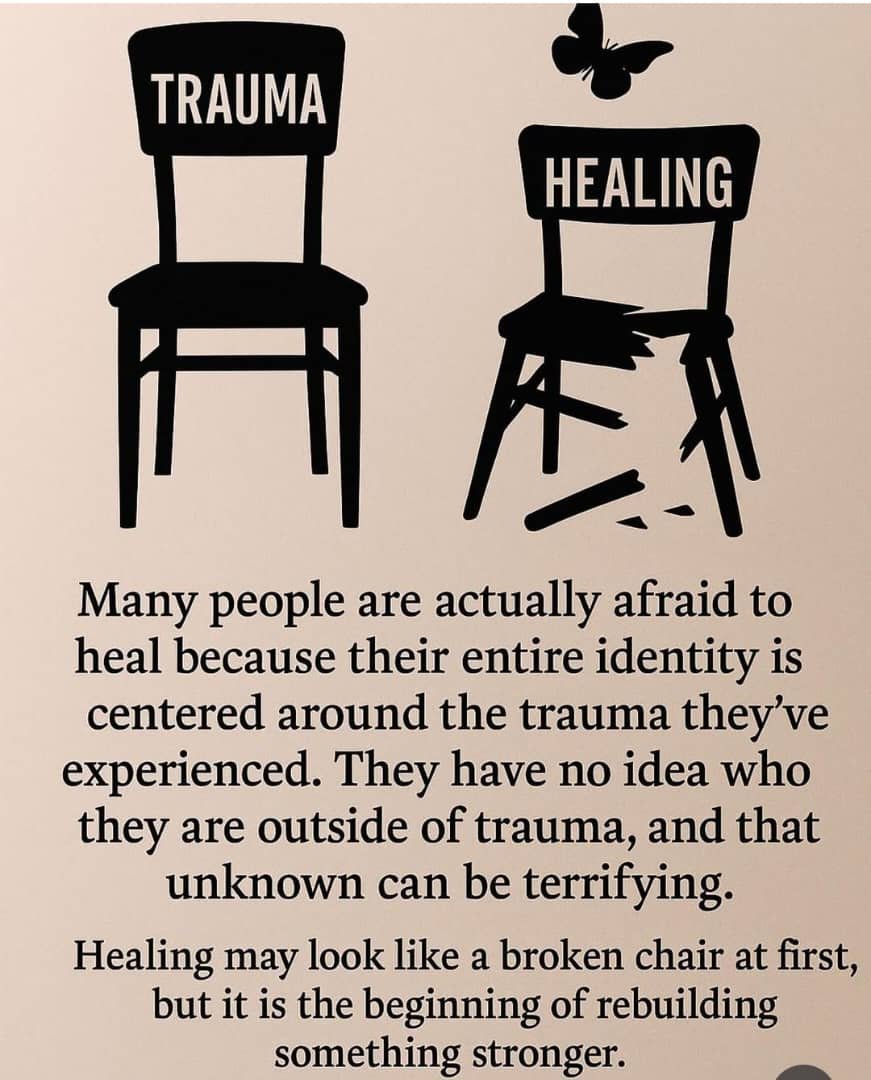
Many people are actually afraid to heal because their entire identity is centered around the trauma they’ve experienced. They have no idea who they are outside of trauma, and that unknown can be terrifying.

Healing may look like a broken chair at first, but it is the beginning of rebuilding something stronger.

Healing isn’t always beautiful at first.

For many survivors, trauma feels like the “safe” chair – solid, familiar, and predictable – while healing feels broken, uncertain, even terrifying. But here’s the truth: what looks “broken” in healing is actually the beginning of rebuilding something stronger, step by step. 6

Trauma healing is not one-size-fits-all. Different therapy approaches can support your journey depending on your needs:

EMDR (Eye Movement Desensitization and Reprocessing): Helps reprocess traumatic memories so they lose their overwhelming power.

Somatic Experiencing & Body-Based Therapies: Release trauma stored in the body, regulate the nervous system, and restore safety.

CBT (Cognitive Behavioral Therapy): Shifts negative thought patterns caused by trauma into healthier perspectives.

DBT (Dialectical Behavior Therapy): Builds emotional regulation, mindfulness, and coping skills.

IFS (Internal Family Systems): Heals inner parts (like the wounded child or protector) with compassion and self-leadership.

Trauma-Informed Talk Therapy: Creates a safe space to process experiences without re-traumatization.

Group Therapy & Peer Support: Reminds you that you are not alone – community is healing.

Healing may feel uncertain, but every step you take is proof of your courage. You are not broken. You are rebuilding. And you are not alone.

How to break your phone addiction

How to break your phone addiction.

Phone addiction is when your brain starts relying on your phone to avoid discomfort. It becomes the fastest way to deal with stress, boredom, or loneliness. The More

It Brings, the more your brain depends on it.

Eventually, it becomes automatic. You reach for it without thinking.

Just when it drains you. Just when it pulls you out of your own life. You still reach for it.

When is it a problem?

* You open your phone mid-task and forget what you were doing

* You scroll when you feel overwhelmed or overstimulated

* You check it before you even get out of bed

* You carry it from room to room, even when you’re not using it

You check it during quiet moments even when nothing’s happening.

* You reach for it during conversations

* You feel answer when it’s not nearby

Why its hard to stop

Your brain is wired to fix discomfort fast. Your Phone Offers Instant Relief Within Seconds. So it becomes the fastest fix.

And the more it works, the more your brain remembers the shortcut:

Bored

Crave Stimulation → Open Phone→ Dopamine

Anxious

Crave Escape → Scroll → Numbness

Lonely

Crave Connection → Check Notifications → Letter Valid

Tired

Crave Rest → Scroll → Quick Hit of Energy

This is the cycle of any addiction relief now. Damage later.

The Damage

To your brain and body

Studies have found that excessive phone use causes real, measurable harm:

It makes your brain slower – even one extra hour can reduce how fast you think.

It shrinks key areas in your brain- that help you

Focus, regular emotions, and stay in control. It Weakens Short-Term Memory – You Forget

More and lose your train of thought • It keeps your brain in “always-on” mode

Harder to rest, harder to relax.

It damages sleep-light, noise, and stimulation all disrupt your natural rhythms.

It causes physical pain-neck strain, tension headaches, and eye fatigue.

The Damage

To your relationships and self

* It Kills Connection – People feel less seen and heard when a phone is visible.

It lowers empathy – your brain becomes less attuned to others when you’re distracted.

. It Fuels Self-Criticism – Constant Comparison increases Anxiety, Shame, and Self-doubt.

C Distors Identity – When your sense of self gets shaped by likes, algorithms, and how others perceive you

It Hurts Relationships – People feel dismissed, less satisfied, and emotionally

Distant.

It triggers anxiety when it’s not near you – A Real Stress Response (Nomophobia).

How to break the cycle

Interrupt the loop

The closer your phone is, the quicker your brain reaches for it. Add some distance, and the urge will start to fade.

When you’re working → Leave it in another room when you’re eating → Put it in a drawer when you’re walking → Leave it at home when you’re with someone → Keep it out of sight when you’re watching TV → Toss it on the couch when you’re bored → Sit with it. Just for a minute.

Small Distances Break Big Habits.

How to break the

cycle

The Three Zones

Your nervous system reacts to where you use your phone- not just what’s on it. These zones are where your body expects calm and safety. Using your phone here takes that away and pulls you deeper into the addiction loop.

The Bed

Your Brain Expects: Rest, Stillness, and Safety. Phones Trigger: Dopamine, Alertness, Blue Light, and Disconnection.

Phones in bed = lighter sleep, timacy, and a brain that forgets how to shut down. This teaches your nervous system to crave stimulation – even where it should unwind.

Your Brain Expects: Presence, Digestion, and

The Table

Connection.

Phones Trigger: Multitasking, Scanning, Anda Low-grade Stress.

phones at the table = slower digestion, less. Presence, and Weaker Connection.

About Time, Even Shared Moments Become Another Place Your Brain Chases Stimulation.

Your Brain Expects: Motion, Unpredictability, and Focus.

The Car

Phones Trigger: Split Attention and Sensory Overload.

Phones in the car = A Nervous System Stuck in overdrive..

Even Passive Moments Become Dopamine Driven – Making Stillness Feel Uncomfortable,

How to break the cycle mornings matter

Right after you wake up, your brain enters theta and alpha states – The ones most open to change. This is when it’s easy to build new habits and reshape old ones.

Think of your brain like wet cement in the mornings. Whatever touches it first leaves a mark.

→ If you scroll first: you train your brain for overstimulation, urgency, and other people’s lives.

→ If you move, breathe, and ground first: you train it for calm, clarity, and regulation.

How to break the cycle

Less access

Your brain isn’t addicted to your phone. It’s addicted to how easy it is.

So make it harder:

Move your most-used apps to the last page switch to grayscale mode (no more

Dopamine Colors) • Use a Screen Time Passcode Someone Else Knows

* Log out of apps daily so you have to retype

Your password

* Delete apps from your phone and use the browser version (slower, clunkier = less

tempting)

* Wear a watch so you stop checking your

Phone “Just for the time”

Leave your charger in another room so your phone isn’t the last and first thing you touch

How to break the cycle

Ride the wave

That urge to check your phone?

It’s not a need. It’s a dopamine surge looking for relief.

Your brain releases dopamine before you even open your phone, not after. That surge peaks fast and fades in about 90 seconds.

If you can pause, you can rewire:

→ Exhale slowly

→ Say: “This is just a wave”

→ Wait 90 seconds before grabbing the phone

Those 90 seconds are where the change happens. You’re not fighting the urge, you’re training your brain to respond differently.

How to break the cycle

Meet Your Needs

Most scrolling isn’t about the phone. It’s your nervous system reaching for what it actually needs.

Overstimulated? You need stillness.

Try: Lying Down, Dim Lighting, Earplugs, Or Covering Your Eyes.

Bored?

You need movement.

Try: Music, Stretching, Walking, Or Changing Your Environment.

Lonely?

You need connection.

Try: A Phone Call, Eye Contact, Physical Touch, or Shared Presence.

Stuck?

You need release.

Try: shaking, humming, dancing, journaling, or cold water on your

Face.

Tired?

You need rest.

Try: Laying Flat, An Eye Mask, Silence, Or Stepping Outside.

How to break the cycle

The Two Week Reset

You don’t need a total detox. You need 14 Honest Days.

Research found that limiting social media to 30 minutes / day for just 2 weeks improved:

→ Mood

→ Sleep

→ Motivation

→ Focus

→ Life Satisfaction

Try this:

Set A 30-Minute Daily Limit for Social Media

Write down how often you pick up your phone, what time you go to bed, and how you feel each day

* On day 14, compare your mood, energy, and focus to

Day 1

* Keep what helped. Let go or what didn’t.

Phones aren’t going anywhere and no one’s asking you to quit.

We work from them.

We maintain relationships through them. We even build our hobbies and identities around Them.

But these devices were designed to hook your brain. Every swipe, ping, and scroll is engineered to keep you coming back. And most of us don’t even realize it’s working.

This isn’t about removing your phone.

It’s about understanding what it’s doing to your focus, your body, your relationships and making a

Conscious Choice.

We aren’t made to be available all the time.

We’re not built to chase stimulation every second.

We were made to rest.

to focus.

to connect.

To be where we are.

Start small, start today.

I created this guide because phone use has tasks about more than we realize. We open it to check one thing and suddenly we’ve lost hours. We’re overstimulated, disconnected, and constantly distracted and most of us don’t even realize it’s happening. The damage it’s doing to our brains, our focus, and our relationships is real. This isn’t about shame. It’s about understanding what’s going on and learning how to actually change it.

This one also me like a week- it was impossible to include everything but I hope I included enough.

HEALTH ANXIETY FACT SHEET

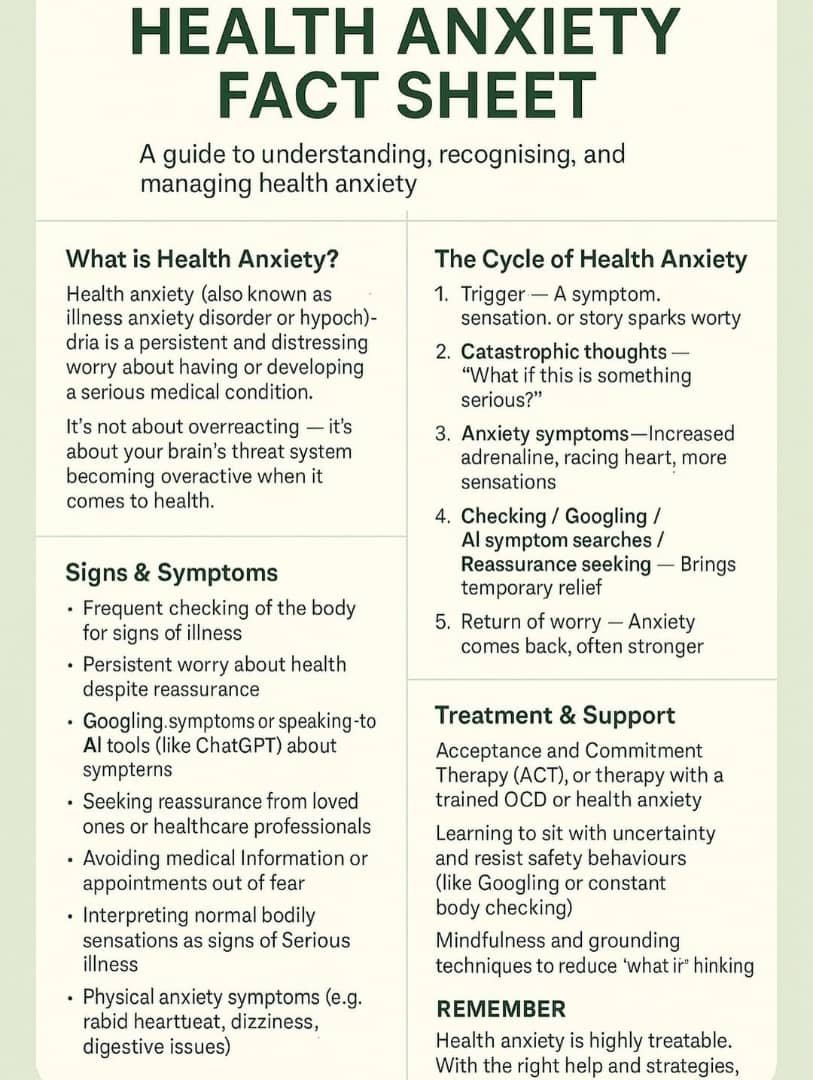
HEALTH ANXIETY FACT SHEET

How long did it take you to realise you had health anxiety? I probably had health anxiety for 2 years until I realised that it was a major problem in my life!
A guide to understanding, recognising, and managing health anxiety

What is Health Anxiety?

Health anxiety (also known as illness anxiety disorder or hypoch)-dria is a persistent and distressing worry about having or developing a serious medical condition.

It’s not about overreacting it’s about your brain’s threat system becoming overactive when it comes to health.

Signs & Symptoms

Frequent checking of the body for signs of illness

Persistent worry about health despite reassurance

Googling.symptoms or speaking-to Al tools (like ChatGPT) about sympterns

Seeking reassurance from loved ones or healthcare professionals

Avoiding medical Information or appointments out of fear

Interpreting normal bodily sensations as signs of Serious illness

Physical anxiety symptoms (e.g. rabid hearttıeat, dizziness, digestive issues)

The Cycle of Health Anxiety

1. Trigger- A symptom. sensation. or story sparks worty

2. Catastrophic thoughts -“What if this is something serious?”

3. Anxiety symptoms-Increased adrenaline, racing heart, more sensations

4. Checking/ Googling /Al symptom searches /Reassurance seeking – Brings temporary relief

5. Return of worry – Anxiety comes back, often stronger

Treatment & Support

Acceptance and Commitment Therapy (ACT), or therapy with a trained OCD or health anxiety

Learning to sit with uncertainty and resist safety behaviours (like Googling or constant body checking)

Mindfulness and grounding techniques to reduce ‘what ir’ hinking

REMEMBER
Health anxiety is highly treatable. With the right help and strategies,

Share your story down below

How much do you know about Sodium.om Cyanide? 7 Industries are involved

How much do you know about Sodium.om Cyanide?

Sodium cyanide is an important basic chemical raw material, used in basic chemical synthesis, electroplating, metallurgy and organic synthesis, medicine, pesticides, and metal treatment. Complexing agent, masking agent. Refining and electroplating of precious metals such as gold and silver.

【Machinery industry】

It is used as a quenching agent for various steels.
Gold and silver.

Machinery industry

It is used as a quenching agent for various steels.

Electroplating industry

It is the main component for plating copper, silver, cadmium, and zinc. In the electroplating solution, it can reduce the polarization of the anode, ensure the normal dissolution of the anode, stabilize the plating solution, and increase the polarization of the cathode to obtain a uniform coating.
Metallurgical industry】

It is used to extract precious metals such as gold and silver.

Chemical industry

It is a raw material for the manufacture of various inorganic cyanides and the generation of hydrocyanic acid. It is also used to manufacture copolymers of organic glass, various synthetic materials, nitrile rubber, and synthetic fibers.
Dye industry】

It is used to manufacture cyanuric chloride (an intermediate for reactive dyes and a raw material for the production of whitening agents). [2]

Pharmaceutical industry

It is used to manufacture methyl cyanoacetate and diethyl malonate.
Textile Industry】

It is used as a mordant in the textile industry and is also used for liquid carburizing and nitriding of steel.

The important inorganic cyanides produced directly from sodium cyanide include sodium cyanide, potassium cyanide, potassium cyanide, zinc cyanide, barium cyanide, cuprous cyanide, sodium thiocyanide, and potassium thiocyanide; organic cyanides include cyanoacetic acid, malononitrile,
The important inorganic cyanides produced directly from sodium cyanide include sodium cyanide, potassium cyanide, zinc cyanide, barium cyanide, cuprous cyanide, sodium thiocyanide, and potassium thiocyanide; organic cyanides include cyanoacetic acid, malononitrile, methionine, benzyl cyanide, and cyanuric chloride. The main products produced by using sodium cyanide to produce hydrogen cyanide include: methyl methacrylate, butyl methacrylate, methacrylic acid, azobisisobutyronitrile, azobisisoheptonitrile, nitrilotriacetic acid, hydroxyacetonitrile, etc.

20 DAILY MICRO-HABITS THAT RESHAPE THE ANXIOUS BRAIN

HABITS THAT RESHAPE THE ANXIOUS BRAIN.

Your brain isn’t broken-it’s just been wired for survival.

When you live with anxiety, your nervous system is used to scanning for danger. These micro-daily

habits send it a new message: “You’re safe. You can soften. You don’t have to brace anymore.”

Healing anxiety doesn’t happen all at once-it happens in the tiny, repeated moments when you choose a new response.

Here are 20 science-backed, therapist-approved daily habits that gently rewire your anxious brain

Save this list to build your healing routine

Comment “HABIT” and I’ll DM you a printable version for to add to your healing toolkit

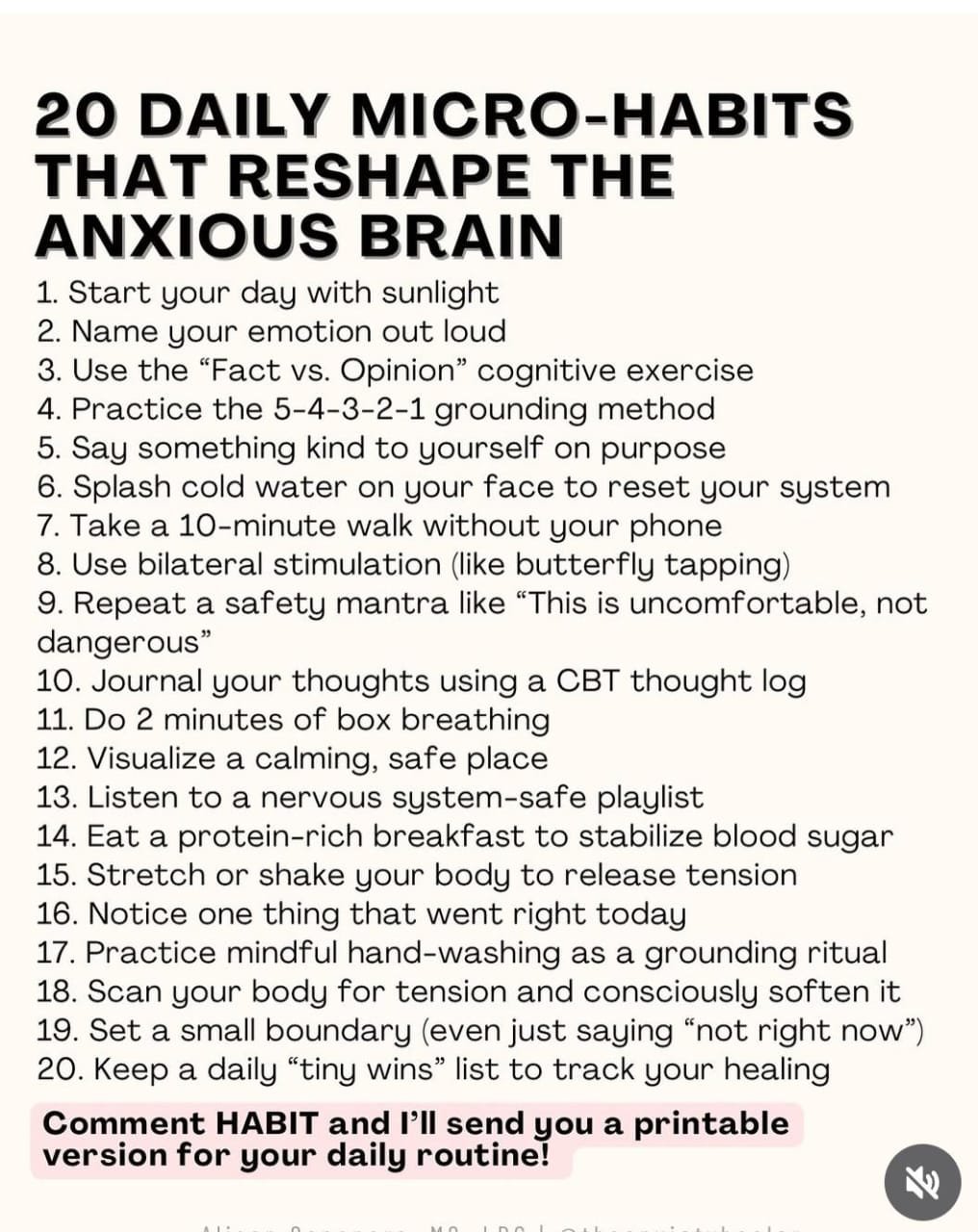
20 DAILY MICRO-HABITS THAT RESHAPE THE ANXIOUS BRAIN

1. Start your day with sunlight

2. Name your emotion out loud

3. Use the “Fact vs. Opinion” cognitive exercise

4. Practice the 5-4-3-2-1 grounding method

5. Say something kind to yourself on purpose

6. Splash cold water on your face to reset your system

7. Take a 10-minute walk without your phone

8. Use bilateral stimulation (like butterfly tapping)

9. Repeat a safety mantra like “This is uncomfortable, not dangerous

10. Journal your thoughts using a CBT thought log

11. Do 2 minutes of box breathing

12. Visualize a calming, safe place

13. Listen to a nervous system-safe playlist

14. Eat a protein-rich breakfast to stabilize blood sugar

15. Stretch or shake your body to release tension 16. Notice one thing that went right today

17. Practice mindful hand-washing as a grounding ritual

18. Scan your body for tension and consciously soften it

19. Set a small boundary (even just saying “not right now”)

20. Keep a daily “tiny wins” list to track your healing

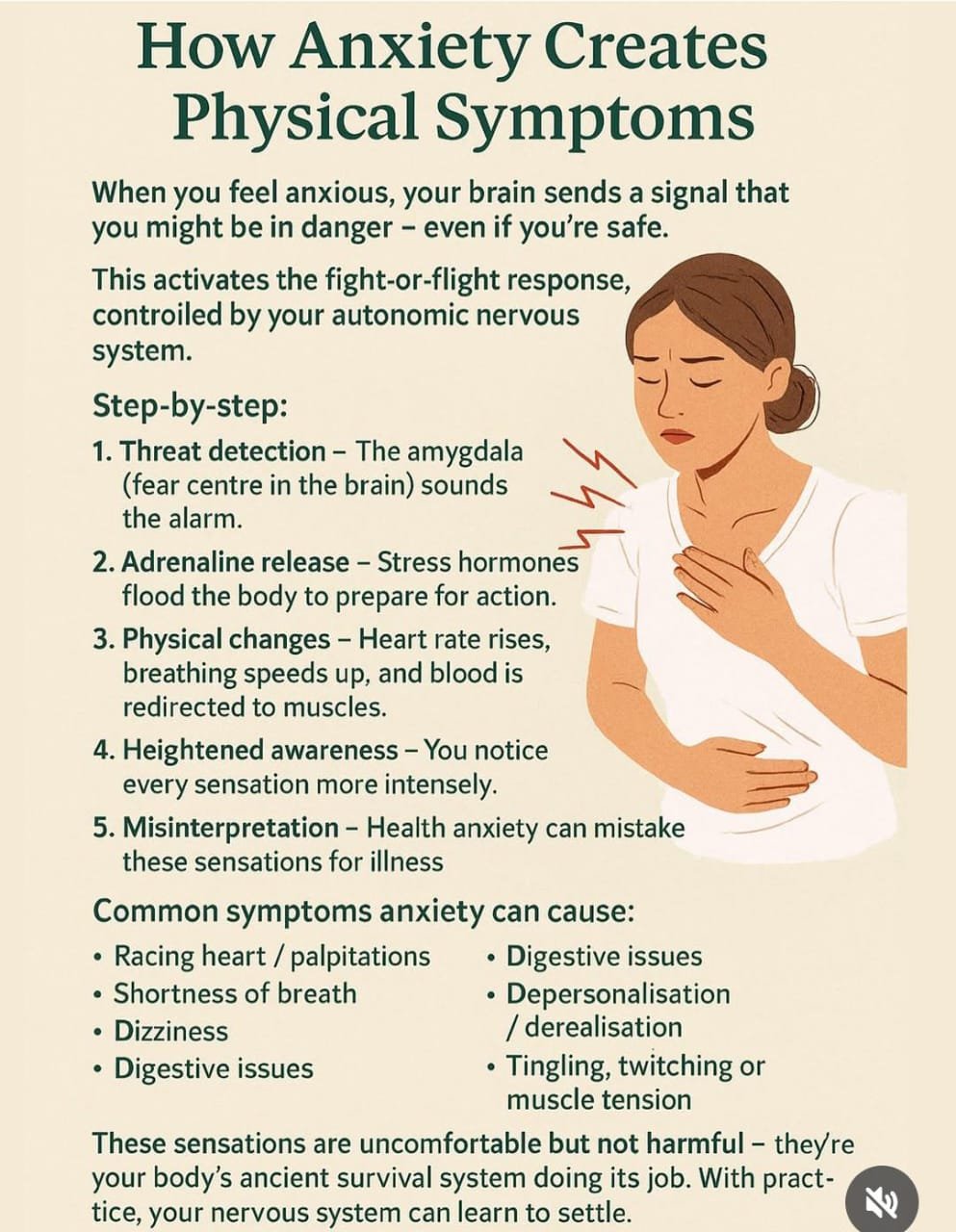
How Anxiety Creates Physical Symptoms

How Anxiety Creates Physical Symptoms

When you feel anxious, your brain sends a signal that you might be in danger – even if you’re safe.

This activates the fight-or-flight response, controiled by your autonomic nervous system.

Step-by-step:

1. Threat detection – The amygdala (fear centre in the brain) sounds the alarm.

2. Adrenaline release – Stress hormones flood the body to prepare for action.

3. Physical changes – Heart rate rises, breathing speeds up, and blood is redirected to muscles.

4. Heightened awareness – You notice every sensation more intensely.

5. Misinterpretation – Health anxiety can mistake these sensations for illness

Common symptoms anxiety can cause:

Racing heart / palpitations

Digestive issues

Shortness of breath

Depersonalisation / derealisation

Dizziness

Digestive issues

Tingling, twitching or muscle tension

These sensations are uncomfortable but not harmful – they’re your body’s ancient survival system doing its job. With pract-tice, your nervous system can learn to settle.
Your body isn’t broken – it’s responding to a false alarm.

When you live with health anxiety, everyday sensations can feel genuinely terrifying.

A flutter in your chest… a wave of dizziness… a strange tingle – and suddenly your mind is racing to the worsttttttt case scenario.

But here’s the truth:

These feelings are often the result of your fight-or-flight system doing exactly what it was designed to do. Anxiety tells your brain there’s danger, and your body reacts completely safe. even when you’re

Understanding why these symptoms happen is a powerful first step in breaking the cycle of fear.  How Anxiety Creates Physical Symptoms

Have you noticed certain symptoms show up more when you’re anxious?

Save this post as a reminder that uncomfortable doesn’t mean unsafe.

Address

10671 Roselle St San Diego, CA 92121

WHATSAPP US

+1 754 319-9553

pimechemicals@gmail.com

Download the app now!

OUR BLOG CONTENTS

At pimechemicals, we are committed to providing high-quality and reliable supplies of MDMA, Mescaline, Ketamine, Crystal Meth, and Ecstasy etc to chemists and cunsumers  all around the world. Our company was established in 2005 by a team of experienced chemists who saw a need for a trusted and reputable supplier in the research chemical industry.

PRODUCTS CATEGORIES

INFORMATIONS

Our Payment Partners :

Copyright © 2025 pimechemicals. All Rights Reserved.

Add to cart